The Shelf Without the Stoned: A Level-Headed Guide to CBD, CBG, and Minor Cannabinoids
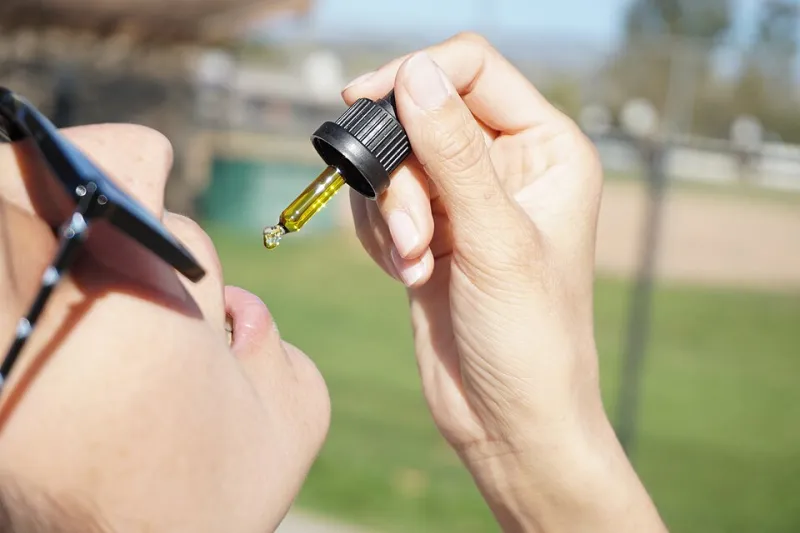
Photo: Elsa Olofsson, CC BY 2.0, via Wikimedia Commons
Walk into almost any dispensary or health-food aisle in 2026 and you'll find a shelf that didn't really exist a decade ago: tinctures, softgels, balms, and seltzers built around cannabinoids that are marketed as something you take rather than something that takes you. No giggling. No couch-lock. Just a dropper, a label, and a promise.
That promise deserves both an open mind and a raised eyebrow. Non-intoxicating cannabinoids—CBD and CBG chief among them, with CBC, CBN, and CBDA crowding in—are a legitimate category worth understanding. They're also a category where honest information competes with some of the loosest marketing in the wellness business. This is the grounded version.
First, What "Non-Intoxicating" Actually Means
CBD doesn't get you high in the way THC does. It binds weakly at the CB1 receptor—the one largely responsible for that stoned feeling—and it doesn't produce the same euphoria or impairment. CBG works along similar lines. That's the short version, and it's broadly accurate.
The longer version: "non-intoxicating" is not the same as "nothing happens." CBD can make you drowsy. It can take the edge off. Some people feel a subtle body calm, others feel nothing at all, and a few feel mildly foggy. None of that counts as intoxication, but it does count as an effect—one worth paying attention to before you drive, operate a table saw, or decide to double the dropper.
There's also a labeling trap. Some products sold as CBD contain enough THC to register, especially full-spectrum oils. A bottle that legally carries 0.3% THC by weight can still add up across a large dose. If you have a low tolerance or you're THC-averse, that tiny fraction is worth asking about—and it's exactly why batch-level testing matters more than the front of the bottle.
What the Evidence Supports—and What It Doesn't
Let's be precise here, because the hype runs both directions.
The strongest human evidence for CBD involves epilepsy. Purified CBD is an FDA-approved prescription medication for certain rare, severe seizure disorders in children, and that research base is serious. That's a genuine, documented use.
Beyond that, the picture gets blurrier. Trials on CBD for anxiety exist and are promising in places, but many are small, short, or use doses that don't map neatly onto what's on the shelf. Sleep research is thinner still, and much of what circulates online is anecdote wearing a lab coat. CBG has real preclinical interest—lab and animal work on inflammation, appetite, and gut signaling—but human trials are scarce. If a bottle tells you CBG "targets" a specific system in your body with certainty, that's marketing, not science.
None of this means the products are useless. It means the honest claim is modest: some people find these cannabinoids helpful for certain things, the research is early, and personal response varies widely. Anyone selling you more certainty than that is selling you something else.
Dose and Timing: The Unglamorous Basics
Cannabinoid dosing is not like taking an aspirin. There's no clean curve, no predictable hour, and no universal starting point.
A reasonable beginner's approach looks like this:
- Start low. For CBD, somewhere in the 10–25 mg range per dose is a common, cautious starting point. CBG products often run lower. Ignore the influencer who swears by 200 mg at breakfast.
- Give it time. Edible and tincture onset is typically 30 to 90 minutes, sometimes longer on a full stomach. The mistake people make is redosing at minute 25.
- Think in weeks, not hours. If you're experimenting for something like everyday stress or sleep quality, single doses tell you very little. Two to four weeks of consistent use, with notes, tells you much more.
- Watch for the biphasic flip. With CBD especially, more is not always better. Past a certain point, some people report the opposite of the intended effect—more wired, more restless. If that happens, the answer is usually less, not more.
And keep the interaction question on your radar. CBD is processed by the same liver enzymes as a long list of common medications, including some blood thinners and anti-seizure drugs. If you take prescriptions regularly, that's a conversation for your pharmacist or doctor, not a Reddit thread.
The Shopping Checklist
Bring this to the store—physically or mentally.
- Find the COA. A certificate of analysis from an independent lab should be available by QR code or batch number. No COA, no purchase. Full stop.
- Check the batch, not just the brand. Testing is per batch. A great COA from eight months ago tells you little about the bottle in your hand.
- Read the milligrams per serving. Labels love to tout total milligrams per bottle. You care about what's in one dropper or one gummy.
- Know your spectrum. Isolate means CBD only. Broad-spectrum means multiple cannabinoids with THC removed. Full-spectrum means trace THC is present. Pick deliberately.
- Scan for contaminants. Heavy metals, pesticides, and solvents should all appear on the panel—and should all read as passing.
- Be wary of "proprietary blends." If the label won't tell you how much CBG is in the bottle, assume the number is small.
- Separate hemp-derived from dispensary products. The hemp loophole has produced some genuinely intoxicating products—delta-8 among them—labeled in ways that confuse the issue. If you want non-intoxicating, verify it.
- Ignore the cure language. Anything that claims to treat, cure, or prevent a disease and isn't a prescription drug is overstepping, legally and ethically.
Where This Fits in a Mindful Routine
Non-intoxicating cannabinoids are best treated as a small, optional tool—not a foundation. If sleep is your issue, the boring stuff still outranks any dropper: consistent wake times, less late caffeine, a dark room. If it's everyday stress, movement and daylight do more than most bottles can claim.
What CBD and CBG offer is a low-stakes entry point for adults who are curious about cannabis but don't want to be high—a way to explore the plant's gentler edge with clear eyes. That's a fair reason to try. Just keep your expectations calibrated, your labels verified, and your dose small. The shelf without the stoned is worth browsing. It just rewards the skeptic as much as the believer.